Electrician jobs in Netherlands are in high demand. The country is building new homes, renovating offices, installing solar panels and heat pumps, and expanding data centres and factories — all of this needs qualified electricians. Employers in Amsterdam, Eindhoven, Rotterdam, Utrecht and The Hague are looking for electricians for housing, commercial buildings, industry and energy projects.
Unlike packing or cleaning work, electrician work needs training and a qualification. You must understand wiring, circuits, safety rules and Dutch standards. If you already have experience from your home country, many employers will check your diplomas and give you extra training to meet Dutch rules. Some agencies help with this process.
The average salary for electrician jobs in Netherlands is around $3,800 per month. The exact pay depends on your qualification, experience, type of work and location. Industrial and solar electricians often earn more than residential electricians. The Dutch minimum wage is €14.71 per hour from 1 January 2026, but qualified electricians earn well above it, and employees normally build up 8% holiday pay. Always confirm the exact salary, hours and benefits in the written job offer before you travel or sign a contract.
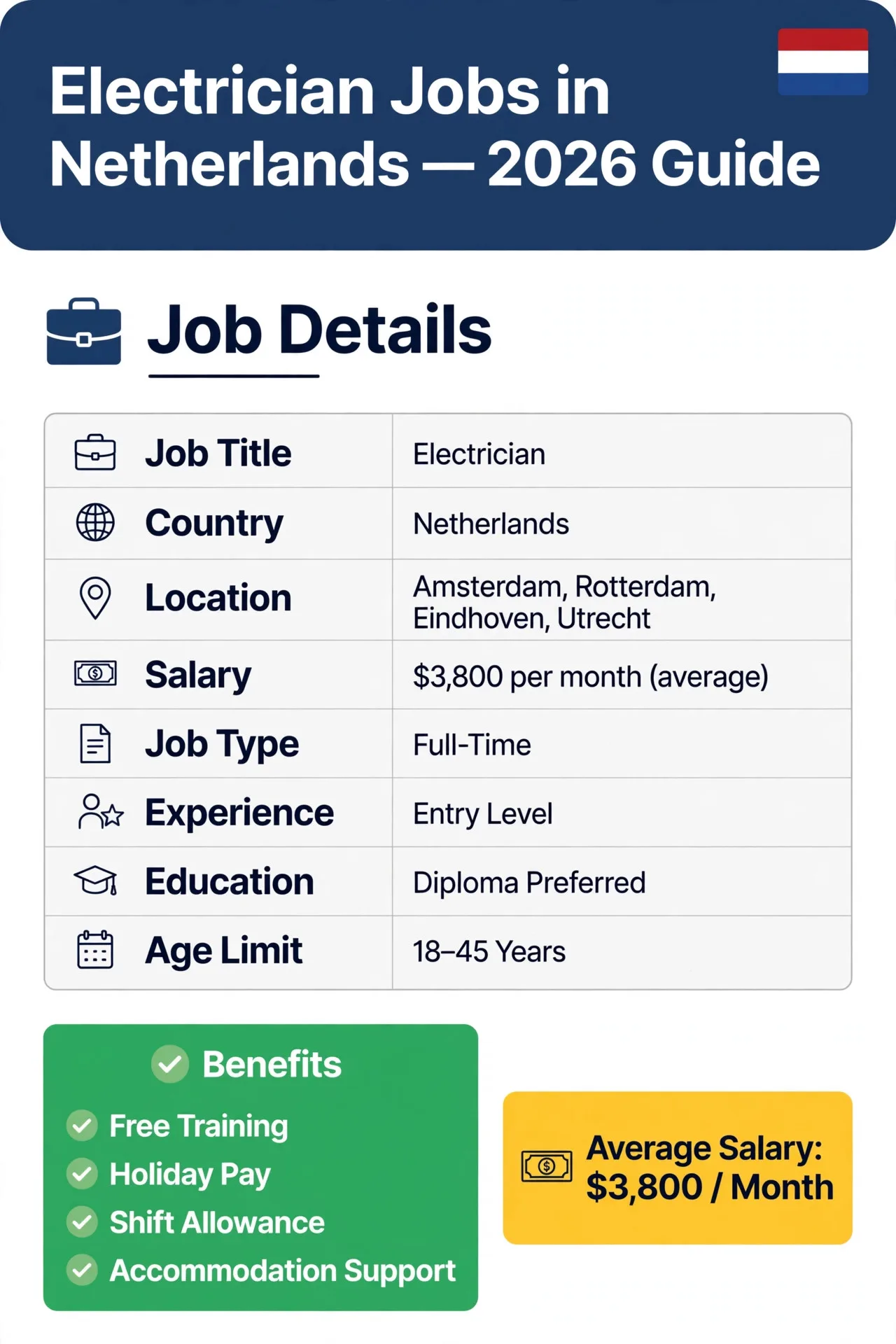
| Job Title | Electrician |
| Country | Netherlands |
| Cities | Amsterdam, Eindhoven, Rotterdam, The Hague, Utrecht |
| Salary | $3,800 per month (average) / approx. €3,268 per month |
| Minimum Wage | €14.71 per hour from 1 January 2026 |
| Job Type | Full-Time |
| Experience | 1–3 Years Preferred (some trainee roles available) |
| Education | Electrical Diploma / Vocational Qualification Required |
| Age Limit | 18–50 Years |
| Application Deadline | 31 December 2026 |
| Work Hours | 40 hours per week, day shifts, occasional on-call |
| Holiday Pay | 8% of gross salary |
| Accommodation | Sometimes provided by agencies — check cost in writing |
| Work Permit | Required for non-EU applicants; EU/EEA citizens do not need a permit |
Note: Salary figures are averages from job listings. Always confirm the exact salary, hours and benefits in the written job offer before you travel or sign a contract.
What Does an Electrician Do?
An electrician installs, maintains and repairs electrical systems. In new homes you install wiring, sockets, lights, fuse boxes and smart-home systems. In offices and factories you install cable trays, distribution boards, lighting and machines. In the energy sector you may install solar panels, EV chargers and heat pumps.
You read drawings and plans, measure and cut cables, connect wires, test circuits and fix faults. Safety is the most important part of the job — you work with live power, so you must follow Dutch safety rules, wear protective equipment and test before you touch. You also keep records of your work and report problems to the project leader or client.
Where to Find Electrician Jobs in Netherlands?
Electricians are needed everywhere, but the most jobs are in Eindhoven, Amsterdam, Rotterdam and Utrecht. Eindhoven is strong for high-tech and industry, Amsterdam for housing and offices, Rotterdam for ports and industry, and Utrecht and The Hague for housing, schools and hospitals. Solar and energy work is available across the whole country.
Many electricians work for an installation company, a staffing agency for technical jobs, or a large contractor. Others work directly for a housing company or a factory. Ask whether you will work on one project for months or move between sites every week, and whether you get a company van, tools and work clothes. Search with different terms: Electrician, Installation Electrician, Industrial Electrician, Solar Electrician, Maintenance Electrician, and Elektromonteur — the Dutch word for electrician.
What Does a Workday Look Like?
A normal day starts at 7:00 or 7:30 at the company or on site. You get your work order, tools and materials, then travel to the site. In housing you may work in one home all day. On a large project you work in a team with other electricians, plumbers and builders.
You will install, connect, test and repair. At the end of the day you clean up, fill in your hours and report finished work. Some jobs include on-call duty for faults in the evening or at weekends — this is usually paid extra. In winter there is more indoor work, in summer more solar and outdoor work.
How Much Do Electricians Earn in Netherlands?
Salary varies by qualification, experience, type of work and collective agreement. Residential electricians earn less than industrial, solar or maintenance electricians. In job ads the salary is usually shown gross per month or per hour — tax and other deductions come off, so the net amount is lower. Compare not only the wage but also the number of hours, travel allowance, tools and training.
For evening, weekend or on-call work you often get an allowance. Check whether a quoted wage already includes allowances. As an employee you normally build up at least 8% holiday pay, plus statutory holidays of at least 4 times your weekly working hours per year. Many employers also pay for courses, certificates and a company van.
Job Responsibilities
- Install wiring, sockets, lights, fuse boxes and distribution boards
- Read drawings, plans and work orders
- Test circuits and fix electrical faults
- Install solar panels, EV chargers, heat pumps and smart systems where trained
- Follow Dutch safety rules and wear protective equipment
- Keep records of work, materials and test results
- Work with other trades on site and report progress to the supervisor
- Keep tools, van and work area clean and safe
Requirements
- Age 18 years or older
- Electrical diploma or vocational qualification — or proven experience plus willingness to do Dutch training
- 1–3 years of experience preferred for most jobs; trainee roles exist for juniors
- Able to read drawings and follow safety rules
- Careful, reliable and able to work alone and in a team
- Basic English is enough for most teams; Dutch is a strong advantage for client work
- Valid passport and the right to work in Netherlands (or a work permit arranged by the employer)
- Driving licence is an advantage for many jobs
Benefits
- Monthly salary of around $3,800 (average, depending on qualification and work type)
- 8% holiday pay and paid holidays
- Allowances for overtime, on-call and weekend work
- Company van, tools and work clothes in many jobs
- Paid courses and certificates — solar, NEN 3140, EV charging
- Health insurance guidance for workers staying in Netherlands
- Long-term work and a clear path to lead electrician roles
How to Apply for Electrician Jobs in Netherlands?
- Prepare a short CV — your qualification, years of experience, types of work you have done, and when you are available. Add photos of your work if you have them.
- Write 2–3 simple sentences, for example: "I am an electrician with 3 years of experience in housing installations. I am looking for work near Eindhoven and can start soon."
- Apply only through the employer's official website, a known job site, or a registered technical staffing agency.
- Ask in the interview which certificates you need in Netherlands, whether the employer pays for training, and whether you get a van and tools.
- Before your first day, check the address, start time, the name of your contact person, and what to bring.
Warning: Never pay money to an agent just to get a job. A real employer does not charge a fee for recruitment. Do not send copies of your ID or diplomas through an unknown chat account. If someone asks for payment for a visa, a job offer or a certificate before you start work, stop and check the offer with the official sources below.