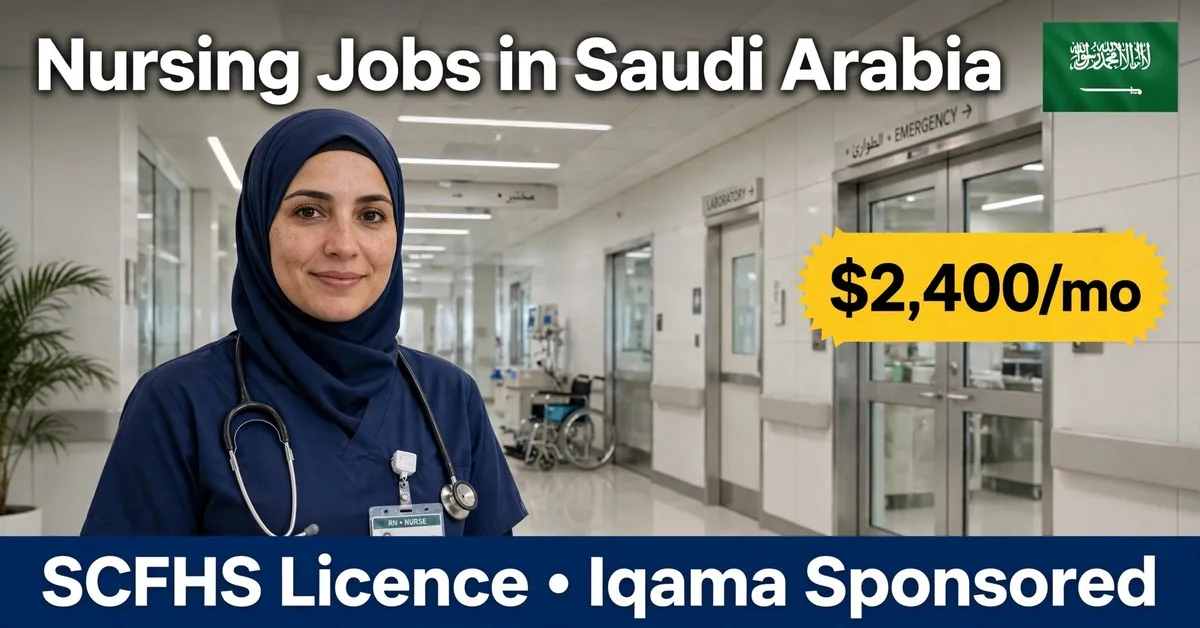
Nursing jobs in Saudi Arabia are among the best-paid healthcare roles open to foreign workers in the Kingdom. Hospitals, medical cities and clinics hire registered nurses all year round, and the work is stable, respected and well organised. Your main work is direct patient care: check vital signs, give medicines, assist doctors, keep records and support patients and their families.
You will usually work in a large government hospital, a private hospital group such as Dr. Sulaiman Al Habib or Saudi German Hospital, or a specialist centre such as King Faisal Specialist Hospital. Saudi hospitals are modern and well equipped, and nursing teams are international, so English is the working language on most wards. Specialists in intensive care, emergency, operating theatres, neonatal care and dialysis are in the highest demand.
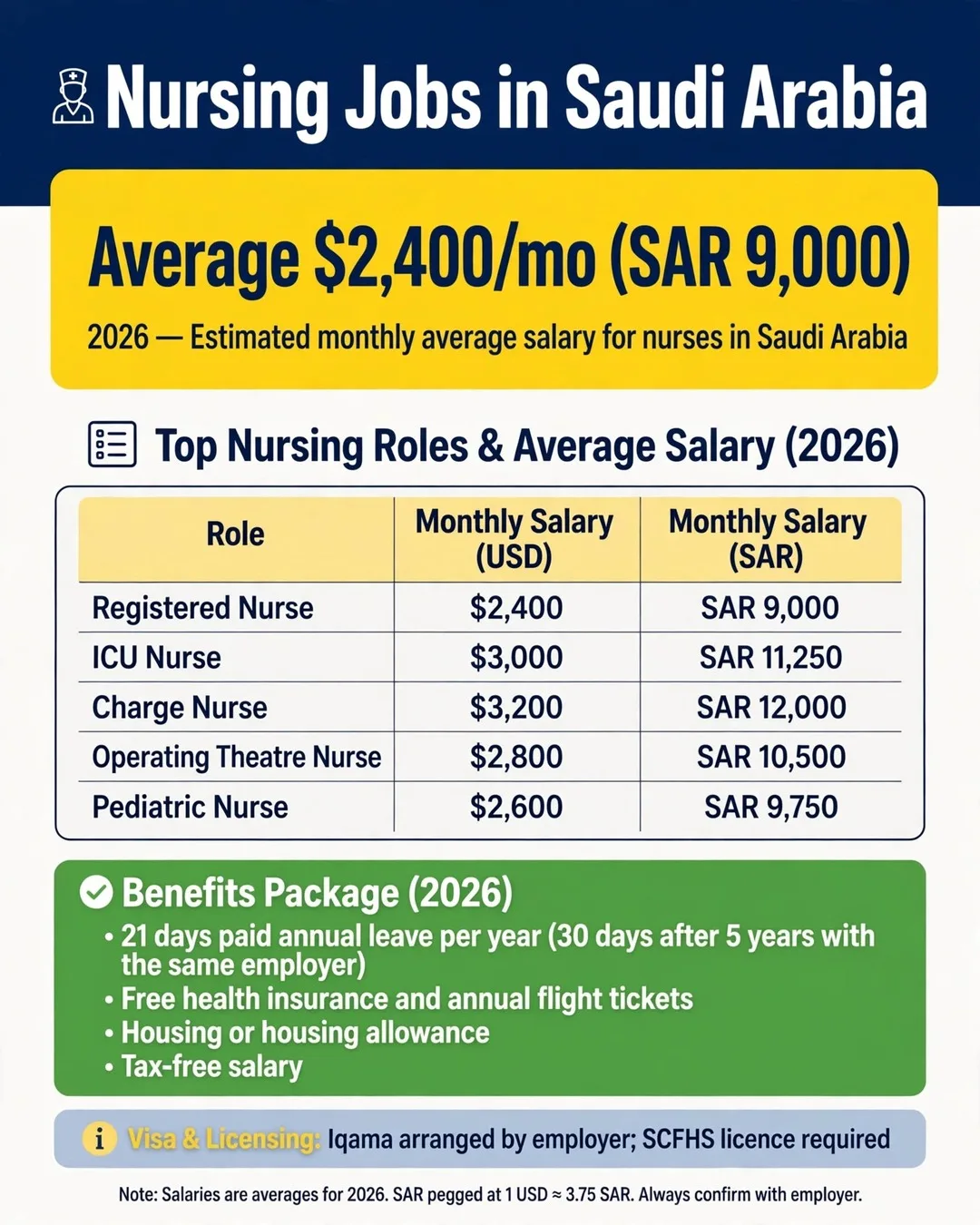
The average salary for nursing jobs in Saudi Arabia is around $2,400 per month (about SAR 9,000). The exact pay depends on your licence, specialty, experience and employer — ICU, ER and NICU nurses earn more than general ward nurses. There is no income tax on salary in Saudi Arabia and most employers add housing, transport and health insurance. You cannot work as a nurse without a Saudi Commission for Health Specialties (SCFHS) licence, so start the licensing process before you apply. Always confirm the exact salary, hours and benefits in the written job offer before you travel or sign a contract.
Job Overview
| Job Title | Registered Nurse / Staff Nurse |
| Country | Saudi Arabia |
| Cities | Riyadh, Jeddah, Mecca, Medina, Dammam |
| Salary | $2,400 per month (average) / approx. SAR 9,000 per month |
| Minimum Wage | SAR 4,000 per month (Saudi nationals; base used for work-visa approval) |
| Job Type | Full-Time |
| Experience | 2+ Years Clinical Experience (most employers) |
| Education | B.Sc Nursing / GNM Diploma + SCFHS Licence |
| Age Limit | 23–45 Years (most employers) |
| Application Deadline | 31 December 2026 |
| Work Hours | 48 hours per week, day / evening / night shifts |
| Holiday Pay | 21 days paid annual leave per year (30 days after 5 years) |
| Accommodation | Housing or housing allowance from most employers |
| Work Permit | Iqama (residence/work permit) arranged by the employer |
Note: Salary figures are estimates from current job listings. Always confirm the exact salary, hours and benefits in the written job offer before you travel or sign a contract.
What Does a Nurse Do in Saudi Arabia?
A nurse in Saudi Arabia provides direct patient care under a doctor's supervision. Your daily tasks include checking blood pressure, temperature and other vital signs, giving medicines and injections, dressing wounds, preparing patients for procedures, updating medical records and explaining treatment to patients and families. In specialist units the work is more technical — in ICU you monitor ventilators and drips, in the emergency room you triage new arrivals, and in the operating theatre you assist the surgical team.
Nursing in Saudi Arabia follows strict international standards. You will work with electronic patient records, follow infection-control rules at all times and take part in regular training. The team is usually large and multinational, and a senior nurse or charge nurse leads each shift. Good communication matters as much as clinical skill, because patients come from many countries and cultures.
Where to Find Nursing Jobs in Saudi Arabia?
Most nursing jobs are in Riyadh (King Faisal Specialist Hospital, King Fahad Medical City, Dr. Sulaiman Al Habib, National Guard hospitals), Jeddah (King Abdulaziz University Hospital, Saudi German Hospital, Dr. Sulaiman Al Habib), Dammam and the Eastern Province (Johns Hopkins Aramco Healthcare, Saudi Aramco hospitals), and Mecca and Medina (large hospitals serving pilgrims, with extra seasonal demand around Hajj and Umrah).
Search the official careers pages of the hospital groups first — Dr. Sulaiman Al Habib, Saudi German Health, King Faisal Specialist Hospital and NMC Saudi all list nursing vacancies directly. Use different search terms: Registered Nurse, Staff Nurse, ICU Nurse, ER Nurse, NICU Nurse, Home Care Nurse, and Ward Nurse.
What Does a Workday Look Like?
A nursing shift in Saudi Arabia is usually 8 to 12 hours, in day, evening or night rotation. The day starts with handover from the previous shift, then you check your patients, give medicines, update charts and carry out the doctor's orders. Ward rounds, admissions and discharges fill the middle of the shift, and the last hour is for documentation and handover to the next team.
Nurses work weekends on rotation. Overtime is paid at 1.5 times the hourly rate, and night shifts usually carry an extra allowance. The standard work week is 48 hours. Ask how the roster is made, how many nights per month you will work, and whether the hospital provides transport for night shifts.
How Much Do Nurses Earn in Saudi Arabia?
Salary varies by licence, specialty and employer. In job ads the salary is usually shown per month in riyals — there is no income tax on salary, so the headline figure is close to what reaches your account. General ward nurses earn around SAR 5,000–9,000 per month, while ICU, ER and NICU nurses earn SAR 9,000–15,000. Senior nurses and nurse managers earn SAR 14,000–25,000. Compare not only the wage but also housing, transport, health insurance and annual flight tickets, as these add a lot of real value.
The figures in this guide are estimates from current listings, not offers. An SCFHS licence and 2 or more years of experience are the two things that raise your pay the most. Nurses with a valid SCFHS classification get hired faster and can negotiate a better package.
Job Responsibilities
- Provide direct nursing care to patients on the ward or in specialist units
- Check vital signs and record patient observations accurately
- Give medicines and injections as prescribed by the doctor
- Assist doctors during examinations, procedures and ward rounds
- Keep patient records and charts complete and up to date
- Follow infection-control, hygiene and safety rules at all times
- Explain treatment and care plans to patients and their families
Requirements
- B.Sc Nursing or GNM Diploma from a recognised institution
- 2 or more years of clinical experience (most employers require this)
- Valid SCFHS licence or classification (DataFlow verification + Prometric exam)
- Good English; Arabic is an advantage but not required
- Age 23–45 years for most employers
- Valid passport and a clean medical fitness result for the Saudi visa
Benefits
- Monthly salary of around $2,400 (average, about SAR 9,000) — tax-free
- 21 days paid annual leave per year (30 days after 5 years with the same employer)
- Free health insurance and annual flight tickets from most employers
- Housing or housing allowance and transport from many employers
- Free SCFHS licence renewal support and continuous training
- End-of-service benefits under Saudi labour law
How to Apply for Nursing Jobs in Saudi Arabia?
- Start your SCFHS licence first — complete DataFlow verification of your degree and experience, then pass the Prometric exam to get your classification.
- Prepare a short CV — your nursing qualification, licence status, specialties and years of experience.
- Apply only through the hospital's official careers page, a known job site, or a registered recruitment agency.
- Ask in the interview about the ward, the shift roster, housing and the licence transfer process.
- Before your first day, check the hospital address, your start time and the name of your contact person.
Warning: Never pay money to an agent just to get a job. A real employer does not charge a fee for recruitment. Do not send copies of your ID or passport through an unknown chat account. If someone asks for payment for a visa, a licence or a job offer before you start work, stop and check the offer with the official sources below.